




Museo di San Salvatore
Pistoia, Italy - 2022
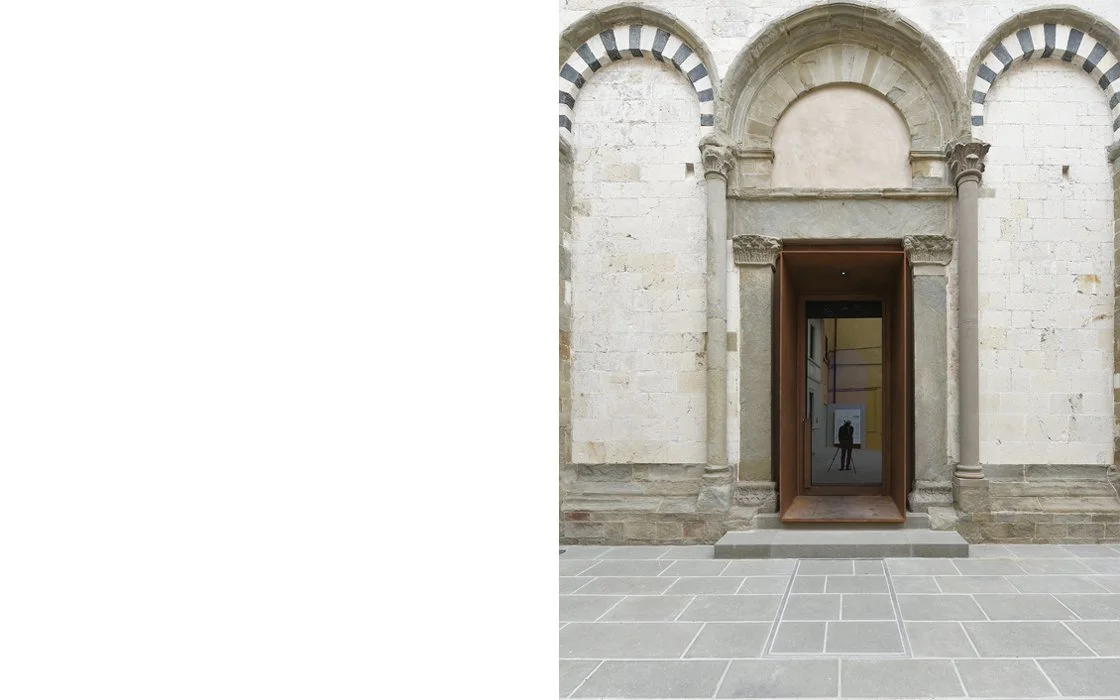
The former Church of San Salvatore in Pistoia is a small example of a Romanesque single-nave church, located within the oldest core of the city. It is documented in historical sources as early as 979 and is considered by some researchers to be the first church built in the city. Repeatedly altered over the centuries, both in its architectural forms and decorative elements, it was closed for worship in 1807 and has since remained largely unused and inaccessible to the public up to the present day. The restoration program envisaged the creation of an exhibition space capable of making the most of the limited available area, ensuring accessibility for people with disabilities, and allowing for a high degree of flexibility in the management of technological systems. The design approach was structured around a dual framework: one more strictly concerned with restoration and conservation of the building, and another of an architectural and compositional nature, aimed at providing a new image consistent with its updated use. The first focused on a set of interventions aimed at structural consolidation and the restoration of deteriorated elements, both structural and decorative, internally and externally. The second concentrated on enhancing the spatial qualities of the building and introducing new architectural elements and finishes designed to define spaces suitable for accommodating the new functions, as well as to ensure the proper integration of new systems and technological equipment. Any mimetic approach was deliberately avoided; instead, clearly distinguishable architectural and compositional solutions were adopted, explicitly legible as a new and additional layer within the historic fabric of the church. All new interventions, both architectural and in terms of furnishings, are characterized by the use of corten steel and by a contemporary, essential language that establishes continuity with the simple and restrained decorative scheme of the late medieval church. In respect of the historical structure, the technical solutions identified and the developed details ensure that the intervention is entirely reversible.